
Apple’s erroneous average power data
Apple’s Health system - including the Health and Fitness apps on the iPhone and the Workout app on the Apple Watch - calculates incorrect average values for a range of data types. The first post in this series provided a brief primer on averages, and how they are calculated on a computer. This post explores the magnitude of this error for cycling average power data using real world measurements.
Energy always equals Power × Time. Power is always Energy ÷ Time.

Average Power is simply Energy ÷ Total Time, where Energy is the sum of each individual Power sample multiplied by the Time interval of the sample.

The error that Apple makes by assuming that the average value is merely the average of the measurements is that the sample time intervals vary greatly. Using data from 50 rides collected over eight months, I was able to produce a reasonably large data set to show the size of the error in Apple’s data. On average, Apple produces a power sample approximately every 0.8 seconds with the standard deviation of the time intervals between samples approximately 1.35 seconds. But, there are occasional outlier samples that dramatically skew the data. On average, the maximum time interval between samples during a ride is approximately 90 seconds, but the largest maximum time interval value I’ve recorded is 894 seconds, or nearly 15 minutes! The histogram of sample time intervals shows a large cluster of data centered on the mean at 0.8 seconds, but also shows a large tail centered near 2.0 seconds, which is nearly one standard deviation from the mean value.
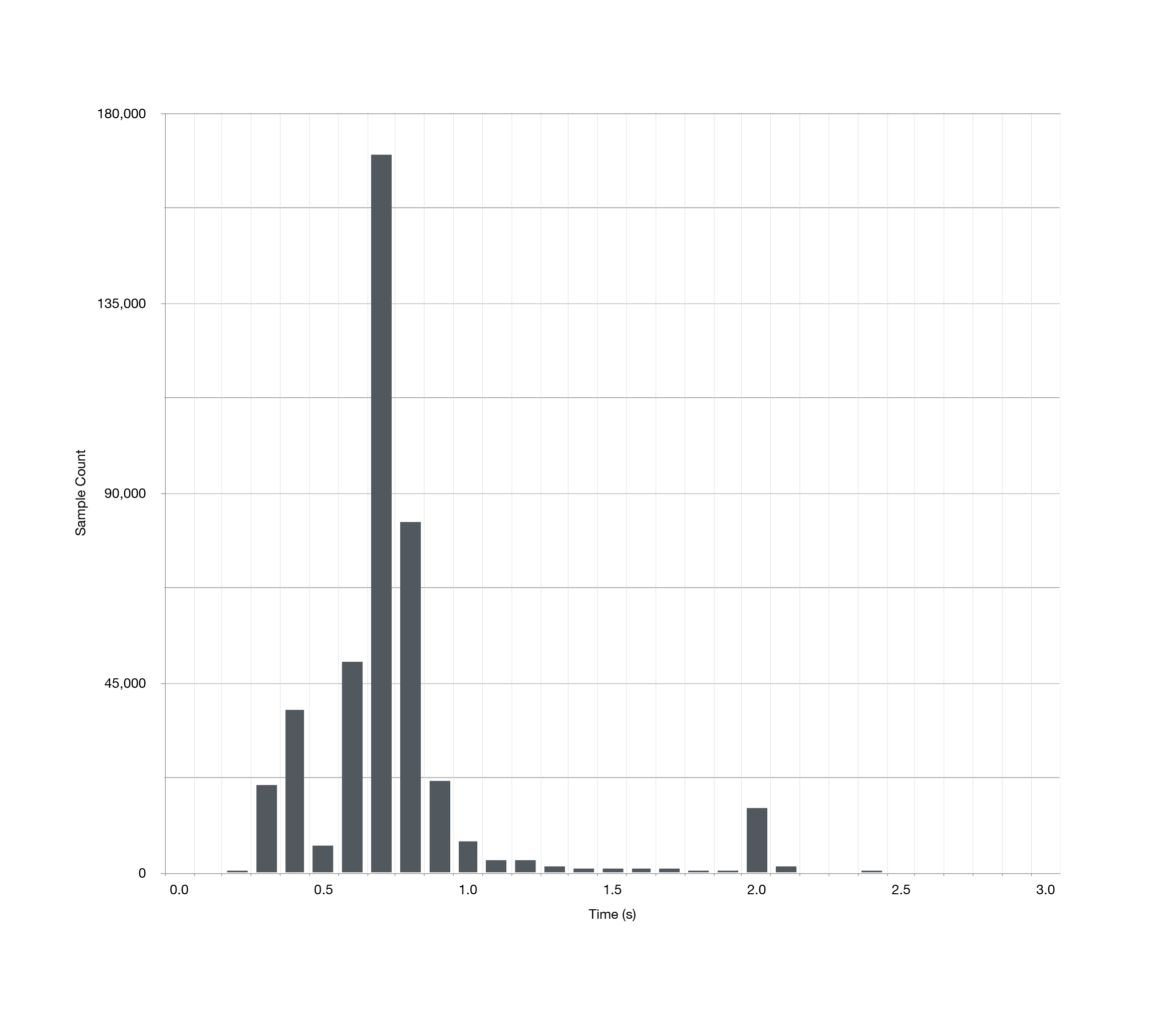
Power sample time intervals recorded on Apple Watch with mean 0.83, standard deviation of 1.35, and max 894.0 seconds
Some devices, such as products from Garmin or SRM, allow for users to only use non-zero values in calculating average power. This value represents the average power when pedaling, instead of the true average power including periods of coasting. The average of non-zero power data is always higher than an average including zeros, particularly since cycling involves frequent coasting at 0 power. In fact, the most common power sample I collected in the data set was 0 watts.
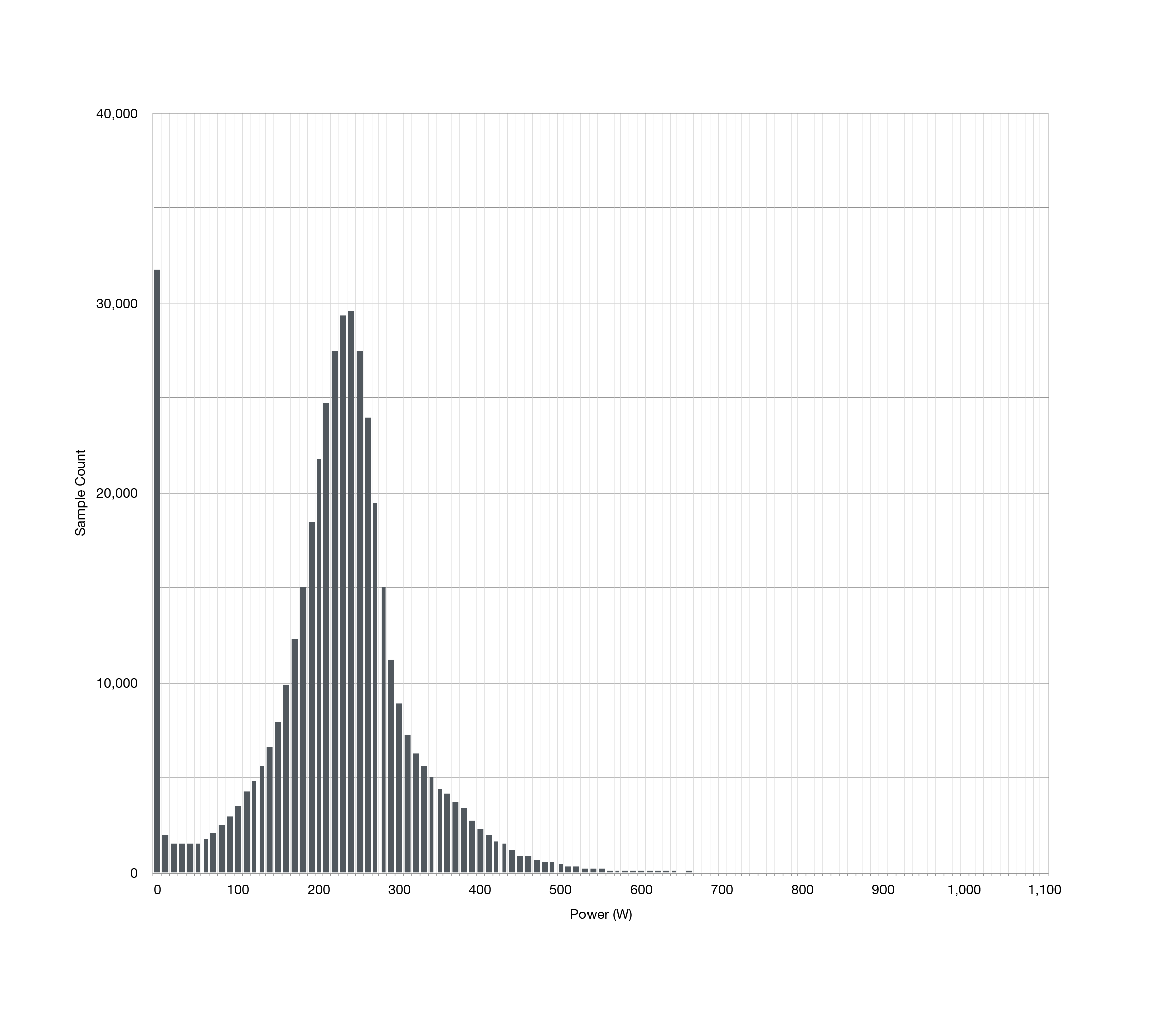
Distribution of cycling power samples in eight month data set - 0 watts is the most common value
Apple’s calculation - by ignoring the time interval of the sample - produces a third value. It includes zero power data, but by ignoring the time interval of each sample, produces an average power reading that lies between non-zero average power and average power with zeros. The average power including zeros over the eight month data set was 189.8 watts. The non-zero average power was 230.2 watts. The average value reported by Apple was 219.8 watts. The Apple data had an average error of 4.89% when compared with the average non-zero value. But, since the Apple data includes zero-values, the correct comparison is with average power including zeros. The error in that case is 13.76%!
Consider how these errors present themselves in a specific ride. For a ride recorded on May 11, 2024 using a Specialized Tarmac SL7 S-Works equipped with a Shimano Di2 crankset and a 4iii Precision Pro dual-sided power meter, Apple reported an average cycling power value of 225.7 watts (displayed rounded down as 225 watts instead of 226 watts). The true average power with zeros was only 189.3 watts. Without zeros, the average power value was 236.3 watts. The Apple reported data represents a 4.70% error from the non-zero average power and a 16.13% error when compared to the true average power with zeros.
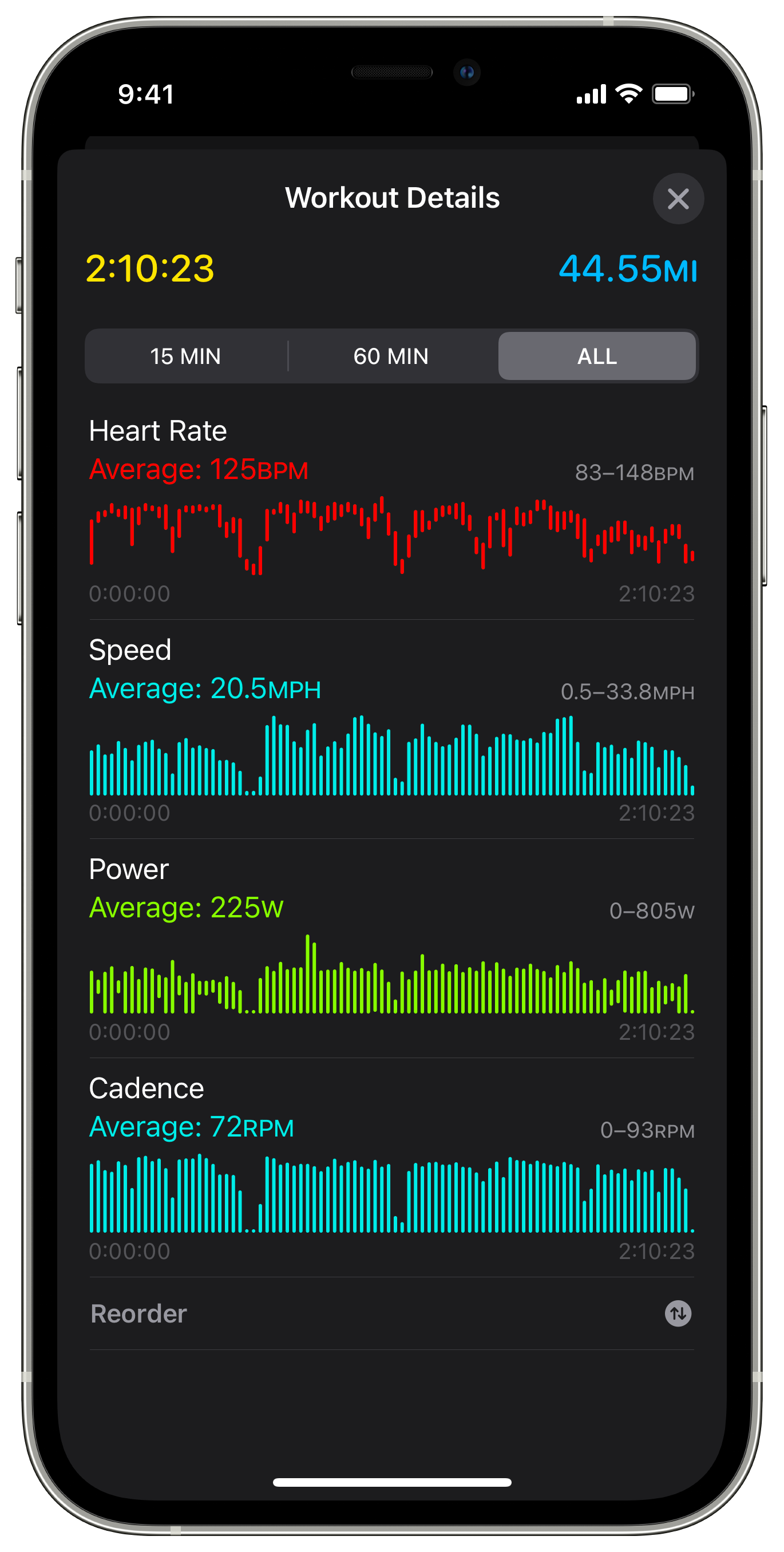
Apple reported power data with a 16% error for a May 11, 2024 workout
The Apple average power data isn’t even correctly rounded to 226 watts!
As a secondary check of Apple’s power data, we can use the reported active energy data to compute average power for the workout. Power is always Energy ÷ Time, so if you have a total energy value and a total time value you can determine the average power. 2,003 kCals is 8,380 kJs. The 2:10:23 ride time is 7,823 seconds. The average power is 8,380 ÷ 7,823 or 1,071.3 watts. Cycling power is measured at the bicycle cranks, and you must account for the inefficiency of the human body in producing power on a bicycle to estimate the measured value. The efficiency of most cyclists ranges from 20-25%. So, the value that should have been observed to correspond to 2,003 kCals ranges from 214.3 - 267.8 watts. If you perform the same calculation using the true average power, or the non-zero average power (average over only 6,264.7 seconds or non-zero power values), you arrive at identical active energy expenditure values ranging from 1,417 to 1,771 kCals. Apple’s reported active energy appears to be substantially overestimated, and corresponds to an efficiency value of only 17.7%.
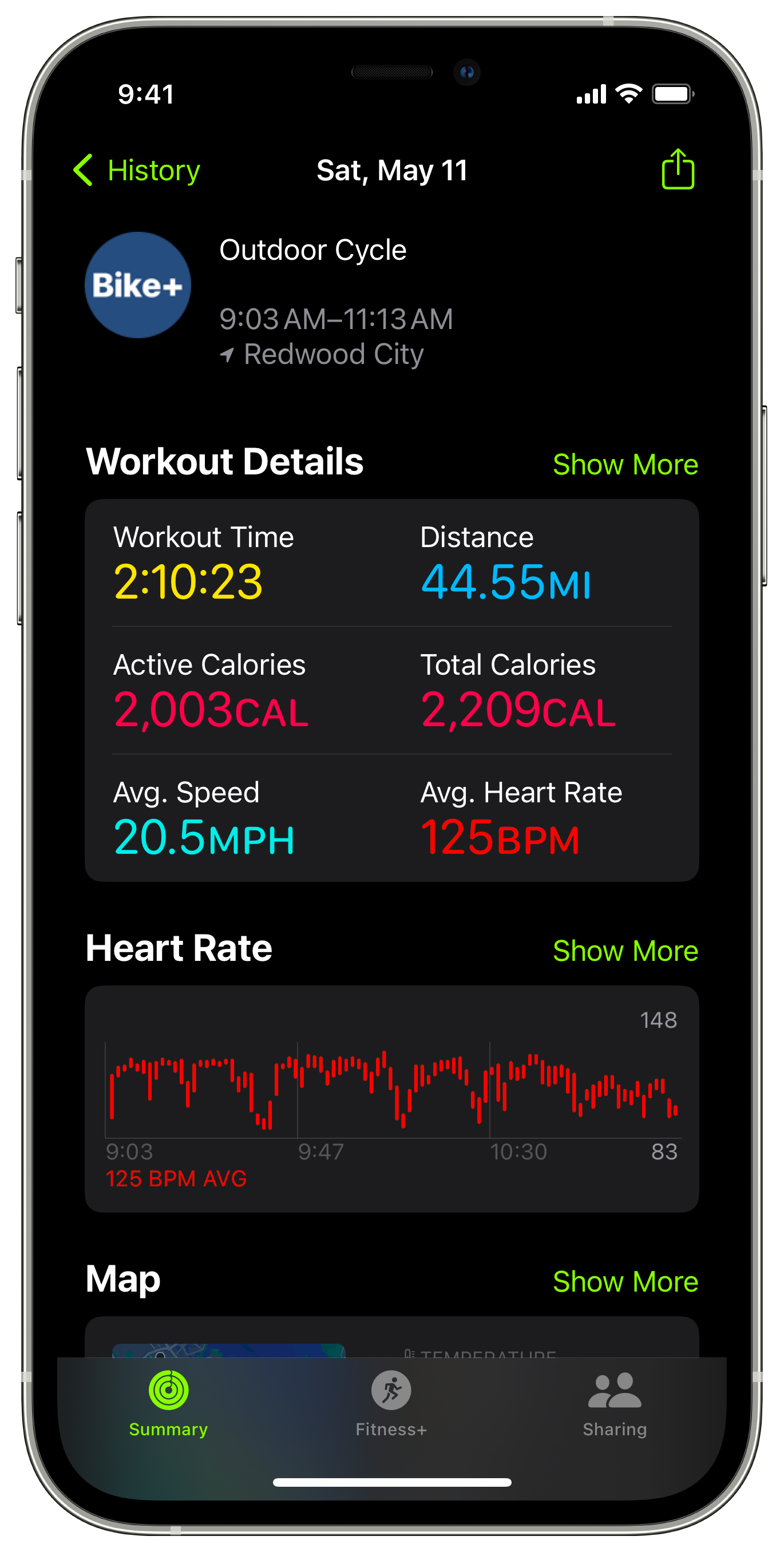
Power calculated from the reported active calories ranges from 214.3 to 267.8 watts
If Apple calculated average power correctly, we would expect to see a constant efficiency value. Instead, we observe a different efficiency value for different rides over an eight month data set. The mean value is 20.0% with a standard deviation of 1.7%.
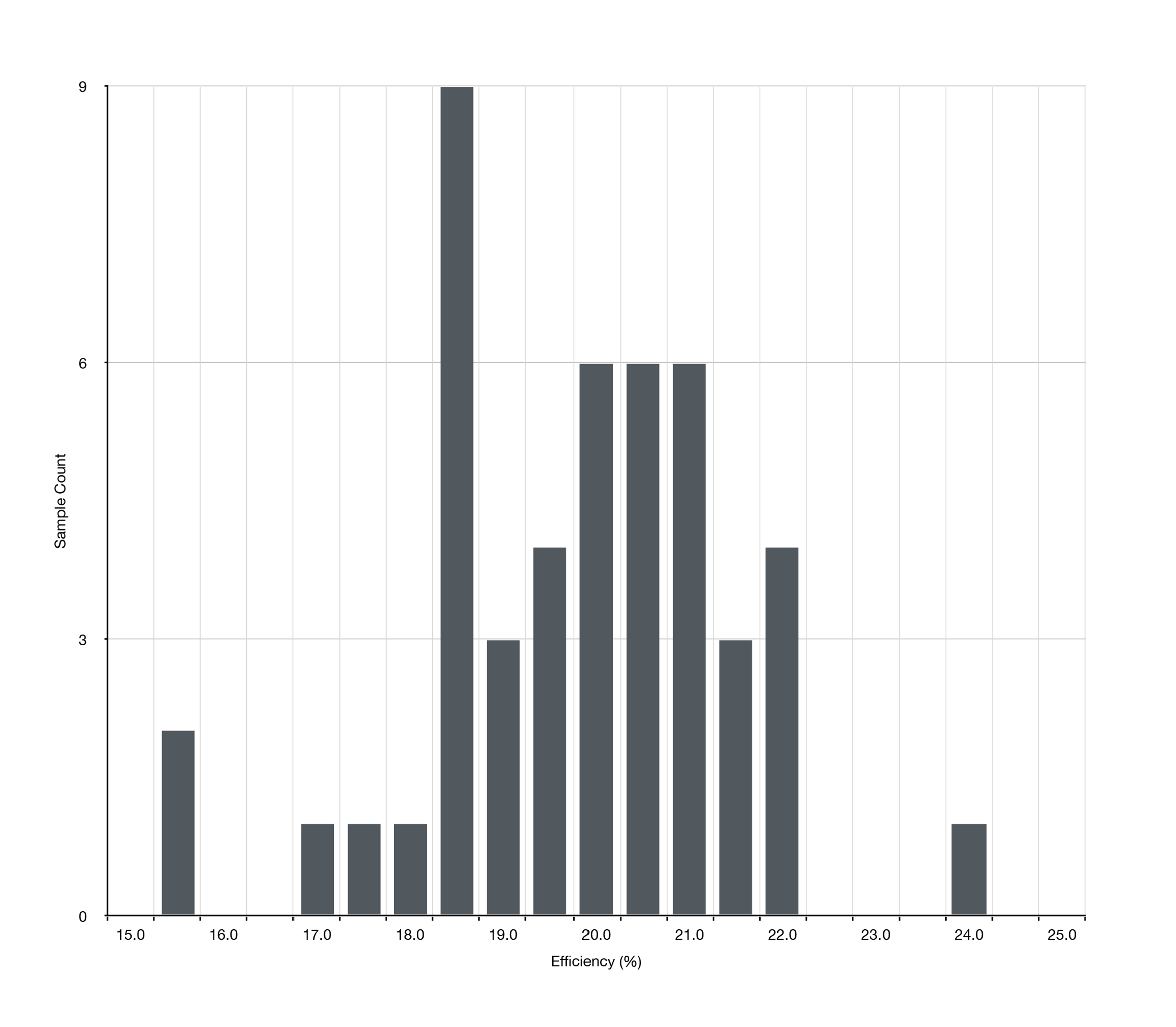
Distribution of cycling efficiency calculated from average power and total energy in eight month data set
Apple’s Health system provides consistently incorrect cycling average power data, with errors on average between 5% and 15%. What is perhaps most concerning with this error isn’t simply the size of the mistake, but that the mere existence of this error suggests that Apple’s health team might not grasp the basic physics of energy and power.